Monthly Archives: January 2007

Economists can’t take (quite) all the blame

Suzuki In the previous article here, I reiterated a fundamental problem with mainstream economics. It fails to recognize that all economic activity is a part of, and as dependent on the ecosystem as any other aspect of human activity or the activities of other species. I urged mainstream economists not to let debates about the details of theory distract them from shifting their view to one in which the economy is viewed in its true relationship with nature. If they can do that, they can truly help to save the world by rethinking our approach to economic growth which, as it stands, is degrading the ecosystem and pushing us toward environmental collapse.

It’s not all the fault of the economists 🙂

But it’s not just mainstream economics which has lost sight of it’s connectedness to the ecosystem. The problem with economics is, in part, likely a reflection of a broader societal phenomenon. Recently, I came across a couple of David Suzuki articles which highlight the seriousness of the problem. (more…)

Can ecological economists save us from the mainstreamers?

Killing the earthMainstream economists are trying to kill us. They don’t think of it that way, but they should. The standard policies promoting endless economic growth of the conventional sort are destroying the ecosystem. And ecocide, should we follow through with it sufficiently, could easily mean the loss of many millions of human lives. When those economists promoting and shaping policy continue to push ecocidal policies when they could instead play a central role in protecting the ecosystem, how is that not homicide? [1] (more…)

The Texas argument

Texas is bigSome people deny the problem of population. They insist that neither the present world population size nor its continuing growth is a problem. Some of these folks are influenced by certain writers, often far to the right politically, and typically focused on mainstream economics, who espouse this sort of population denial. (We’ll look at some of those writers in the future.) Others are merely drawing conclusions from their everyday observations. From neither contingent have I seen a very substantive argument, but a common argument from the second group is especially silly.

Texas is great, but this is ridiculous

Usually, it goes something like this: “There’s no population problem. It’s a myth. You could fit every human being on earth inside the state of Texas with plenty of room for everyone.” You can see an example of this in comments on Anderson Cooper’s blog on the CNN site. (Search the page for the phrase “state of Texas” – without the quotes.) [1] (more…)

Removing vast forests

Deforestation is an ongoing, serious problem for many developing countries. It’s impact is global, however, as the loss of forests and the benefits they provide the ecosystem are felt.

In some parts of the world, local population growth is the major culprit. In the Amazon, while it is self evident that broader population growth creates demands which play an important role, locally most of the guilt goes to classic examples of conventional, unsustainable economic growth. Agricultural giant, Cargill, for example, has been a major player in the deforestation process.

In the Amazon it’s a vicious cycle, with humans clearing the rainforest, contributing to climate change, while climate change causes drying and fires which further destroy the rainforest. Here’s a brief video: (more…)

The UN population report: misunderstood and misused

UN Flag

[The follow-up to this essay is here.]

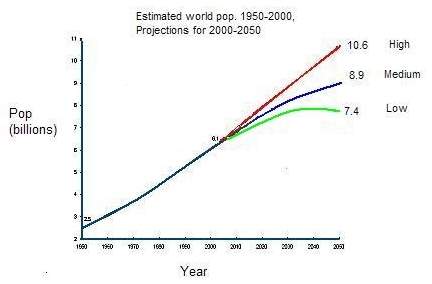
In 2004 the United Nations issued a report titled World Population to 2300. (Large pdf) In it, the demographers who authored the report offer “projections” concerning world population growth through this century and all the way to 2300. The following graph, based on the UN’s, shows the three scenarios or projections for which the report is best known. As you can see, their medium scenario, the one on which most people focus, shows what might appear to be a near peaking of population growth around 2050:

Graph of UN data

I had occasion last year to sit in on a college class in which the students were discussing the issue of world population growth. One student asked the question, “Why should we worry about population growth when the UN says world population will stabilize around 2050?” That’s an important question, and one the student is not alone in having asked. The UN report is cited from time to time by mainstream economists and others who dismiss concern over population growth. (Sometimes those on the far right voice instead a kind of corporate concern about the slowing of population growth in developed countries. That is a topic for a future post.)

Do they have a point? Should we take comfort in UN report? Should we see it as reason to dismiss, at least to some extent, population growth as a serious concern? (more…)

While you were living…

World population growth

While I toil away on a more substantive article (!), I thought I’d point you to an informative, even fun site concerning population issues. It’s a couple of pages of online course material on world population from a biology class at Western Kentucky University. They include a number of links which are well worth following. One, for instance, goes to a PBS site for a Nova program, circa 2000 I believe, on world population, containing lots of fascinating interactive elements, interviews, even sample posters from various country’s campaigns to lower their fertility rates.

Especially telling is the interactive tool (near the top of the page) in which you click the dot to enter your age. It shows you what the earth’s human population was when you were born and how much it has grown since. The amount of growth might shock you, no matter your age. But the older one gets, the shorter one realizes a lifetime is. And I think the older the reader of this post, the more astounding it will be to see how much world population has grown in such a short time.

Please pass the link to this post along to anyone who might be interested to see how much world population has grown in their lifetime.

Note that a few statistics in the materials, including the tool in the image above, appear to be a few years out of date. Still, the general ideas come through clearly.
_______

Image source: Sustainable Scale Project

AddThis Social Bookmark Button

Did someone say, “steady state economy”?

EcoEconTo some extent, I’d like the early posts here to be sequential in laying out a case for the site’s basic arguments. But timely items from around the Web and elsewhere are part of the plan as well. With that in mind, I bumped into a piece on Alternet by Stephan Harding. It’s about the idea of implementing “Tradable Energy Quotas” (TEQs) as a way of promoting a “steady state economy.”

Previously, I’ve mentioned the importance of the idea of the steady state economy. Any thoughtful examination of the current pervasive growth imperative, leads to the conclusion that endless economic growth — with its growth in physical throughput — is unsustainable. Our ecosytem has limits. And such growth is leading quickly to its collapse. A move to a steady state economy would be a key step toward putting on the brakes and taking the ecosystem fully into account in our economic policies. (more…)

Logical Science puts in a word for GIM

Logical Science

GIM is a young site, but I’m happy to report that “Wacki,” author of the Logical Science blog, has already posted some some nice comments about it. The Logical Science blog, as well as the associated conventional site, is one of the best places you can possibly go for information on climate change, particularly if you’re trying to assess the merits of a climate change “skeptic’s” argument. A tireless researcher who knows his subject cold, Wacki has compiled a stunning amount of information on climate change and the arguments used by those who deny it. He has tackled those argments one by one, fully deflating them along the way. As an example, if you ever wonder if a skeptic is right in asserting, as they often have, that “there is no consensus,” simply take a look at his page on the consensus on climate change.

Read the blog for the latest in climate change news.

I’m grateful for the positive comments about GIM, and I aim, over time, to eliminate any doubts Wacki may have about the significance of population growth. 🙂
_______

AddThis Social Bookmark Button

Al Bartlett exposes “the silent lie”

Al BartlettIn mainstream circles, serious acknowledgment of the problem of population growth has, for some years, been more or less taboo. Mentions are made, the occasional article appears, but extended, prominent discussion is rare. A case in point was a recent issue of Scientific American. Al Bartlett, one scientist who does raise the issue of population growth, and whom I mentioned in the previous entry here, reviewed it in the last issue of the The Physics Teacher. The review is now available online at Culture Change.

Conspicuous omission

As I mentioned previously, Dr. Bartlett, physics professor emeritus at the University of Colorado and former national president of the American Association of Physics Teachers, is one of my favorite thinkers on sustainability, population growth, and related issues. He’s been speaking on the topic of population and energy since 1969, and has written some of the clearest, most incisive articles you will find on sustainability-related topics. His review of the Scientific American issue is no exception. (more…)