Admit it Betsy, we agree: part 1

Feminism in conflict with concerns over population growth?Readers here know there are those who argue world population growth is not a problem. Most prominent are groups with certain political axes to grind, usually from a right wing economic perspective, often advocating free market capitalism and opposed to government intervention in environmental matters. Some libertarian “think tanks” typify this group. They tout the party line with regard to the current dominant economic model. I disagree strongly with those groups, have touched briefly on that disagreement in previous essays, and will do so in more depth in the future.

A bit less prominent among critics of the environmental perspective on population is a subset of academics writing from a feminist perspective. They argue any focus on population is a distraction from the real issues, works against women’s rights, and promotes racism and class bias. One of the best known authors from this camp is Betsy Hartmann, director of the Population and Development Program at Hampshire College.

Reading some of her online writings, I set out to examine where she and I disagreed. (more…)

Learning from Lester Brown

Lester Brown We can learn a lot from Lester Brown. By way of introduction, he is an environmentalist with some 50 books to his credit, including Eco-Economy: Building an Economy for the Earth and Plan B 2.0: Rescuing a Planet Under Stress and a Civilization in Trouble. He founded the Worldwatch Institute and the Earth Policy Institute, and is the recipient of a MacArthur Fellowship and the 1989 United Nations Environment Prize.

In the video linked to below, he touches briefly on the relationship between the economy and the environment at its broadest level, an issue we’ve examined here before. (more…)

The specter of mass extinction

One of our companions, for now

If current trends continue, one half of all species of life on Earth will be extinct in 100 years. — E.O. Wilson

What will people do?
After the garden is gone.
— Neil Young

Something terrible is happening. Does anyone notice? A few do. In developed countries, only the more observant see it. From time to time, though, we hear about it in the media. We’re destroying the global ecosystem, our life support system.

Too easy to deny

So what? We don’t have to listen to that. Nothing’s happening here. Sure, there’s not as much open land, we hear about companies cutting down something called “old growth forests,” some animals have disappeared. Big deal, our lives go on about the same. (more…)

Population and consumption: both major players

Growing footprint Consider this a working paper of sorts. It adds to the last post here which discussed the relationship between population and consumption. But it’s only a snapshot of an initial bit of online and library research. I hope to flesh out the topic more fully in the future.

At the end of that post I mentioned two issues I had barely touched on, which deserved more attention. They were (a) the question of whether, even hypothetically, we could ignore population growth and count solely on advances in clean energy technologies to escape ecological catastrophe, and (b) the implications of the observation that over the last century global energy consumption has increased more than population numbers. In my view, the former question is the simpler one, and I’ll get to in the near future. In this post I’ll provide some of what I’ve found concerning the latter issue.

The consumption argument

It’s a common observation that, over the last half century or more, resource consumption rates have increased at a faster pace than population size. I’ve seen this observation used to support the view that population growth isn’t as serious an environmental problem as our growing rates of consumption. Sometimes a proponent of this argument presents data showing that the magnitude of growth of total world energy consumption, or of total consumption of a specific resource, is considerably larger than that of population. (more…)

An unholy matrimony

[The follow-up to this essay is found here.]

The chicken knows
“Overpopulation is a serious problem getting worse every year.”

“Overpopulation is a myth.”

“There is no population problem.”

“There’s overconsumption, … but not overpopulation.”

“[The problem is] overpopulation in the South and overconsumption in the North.”

That’s just a sampling of the kinds of conflicting statements about population growth you can find on the Web and elsewhere. Is it any wonder the topic confuses people? Readers here should have little doubt which of the first three views I share. I would suggest, as well, that statements dismissing the population issue are often disingenuous and politically motivated.

Good question

But what about about the population versus consumption question? (more…)

Economic “his-story” Ă  la Gil Scott-Heron

Gil Scott-Heron in graffiti

Gil Scott-Heron on GIM? It makes sense. I was watching a brief video of GSH addressing how black history was rewritten to suit the dominant white culture in North America, and it struck me that it made an equally cutting commentary on aspects of Western economic history.

Of course, I also just thought it would be cool to get Gil on here. 🙂 He’s long been one of my favorite musicians, as much for his political commentary as for the excellence of his music. Along with long-time collaborator, Brian Jackson, GSH built a unique and significant body of work. He is sometimes called, the “Godfather of rap,” for long before the advent of rap/hip-hop, his “soul jazz” songs were often interspersed with spoken word, poetry-based pieces, invariably expressing intensely felt social messages. The most famous, of course, was The Revolution Will Not Be Televised.

The piece in the video is an adaptation of “Black History of the World” from his album, Moving Target. It’s a snip from a a DVD called Black Wax, parts of which take place in a wax museum: (more…)

If I’m right, do I win a Nobel Prize?

Nobel Medal

It’s not easy trying to spread the word about population growth. Part of the trouble is that others, sometimes highly respected in their fields, spread contrary information. Nobel prize winners go around telling people population growth is a good thing; bring it on! George W. Bush regretted saying such a thing and said so. But the population growth cheerleaders haven’t yet expressed any remorse about their destructive pronouncements. One can only hope that in the end the truth will out.

Gary, we need to talk

While we’re waiting for the truth to win the day, let’s take a quick look at one attempt to convince us we should welcome continued population growth. (more…)

Economists can’t take (quite) all the blame

Suzuki In the previous article here, I reiterated a fundamental problem with mainstream economics. It fails to recognize that all economic activity is a part of, and as dependent on the ecosystem as any other aspect of human activity or the activities of other species. I urged mainstream economists not to let debates about the details of theory distract them from shifting their view to one in which the economy is viewed in its true relationship with nature. If they can do that, they can truly help to save the world by rethinking our approach to economic growth which, as it stands, is degrading the ecosystem and pushing us toward environmental collapse.

It’s not all the fault of the economists 🙂

But it’s not just mainstream economics which has lost sight of it’s connectedness to the ecosystem. The problem with economics is, in part, likely a reflection of a broader societal phenomenon. Recently, I came across a couple of David Suzuki articles which highlight the seriousness of the problem. (more…)

Can ecological economists save us from the mainstreamers?

Killing the earthMainstream economists are trying to kill us. They don’t think of it that way, but they should. The standard policies promoting endless economic growth of the conventional sort are destroying the ecosystem. And ecocide, should we follow through with it sufficiently, could easily mean the loss of many millions of human lives. When those economists promoting and shaping policy continue to push ecocidal policies when they could instead play a central role in protecting the ecosystem, how is that not homicide? [1] (more…)

The Texas argument

Texas is bigSome people deny the problem of population. They insist that neither the present world population size nor its continuing growth is a problem. Some of these folks are influenced by certain writers, often far to the right politically, and typically focused on mainstream economics, who espouse this sort of population denial. (We’ll look at some of those writers in the future.) Others are merely drawing conclusions from their everyday observations. From neither contingent have I seen a very substantive argument, but a common argument from the second group is especially silly.

Texas is great, but this is ridiculous

Usually, it goes something like this: “There’s no population problem. It’s a myth. You could fit every human being on earth inside the state of Texas with plenty of room for everyone.” You can see an example of this in comments on Anderson Cooper’s blog on the CNN site. (Search the page for the phrase “state of Texas” – without the quotes.) [1] (more…)

Removing vast forests

Deforestation is an ongoing, serious problem for many developing countries. It’s impact is global, however, as the loss of forests and the benefits they provide the ecosystem are felt.

In some parts of the world, local population growth is the major culprit. In the Amazon, while it is self evident that broader population growth creates demands which play an important role, locally most of the guilt goes to classic examples of conventional, unsustainable economic growth. Agricultural giant, Cargill, for example, has been a major player in the deforestation process.

In the Amazon it’s a vicious cycle, with humans clearing the rainforest, contributing to climate change, while climate change causes drying and fires which further destroy the rainforest. Here’s a brief video: (more…)

The UN population report: misunderstood and misused

UN Flag

[The follow-up to this essay is here.]

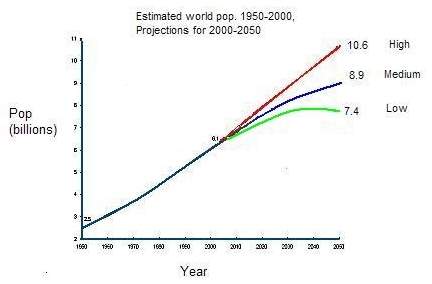
In 2004 the United Nations issued a report titled World Population to 2300. (Large pdf) In it, the demographers who authored the report offer “projections” concerning world population growth through this century and all the way to 2300. The following graph, based on the UN’s, shows the three scenarios or projections for which the report is best known. As you can see, their medium scenario, the one on which most people focus, shows what might appear to be a near peaking of population growth around 2050:

Graph of UN data

I had occasion last year to sit in on a college class in which the students were discussing the issue of world population growth. One student asked the question, “Why should we worry about population growth when the UN says world population will stabilize around 2050?” That’s an important question, and one the student is not alone in having asked. The UN report is cited from time to time by mainstream economists and others who dismiss concern over population growth. (Sometimes those on the far right voice instead a kind of corporate concern about the slowing of population growth in developed countries. That is a topic for a future post.)

Do they have a point? Should we take comfort in UN report? Should we see it as reason to dismiss, at least to some extent, population growth as a serious concern? (more…)

While you were living…

World population growth

While I toil away on a more substantive article (!), I thought I’d point you to an informative, even fun site concerning population issues. It’s a couple of pages of online course material on world population from a biology class at Western Kentucky University. They include a number of links which are well worth following. One, for instance, goes to a PBS site for a Nova program, circa 2000 I believe, on world population, containing lots of fascinating interactive elements, interviews, even sample posters from various country’s campaigns to lower their fertility rates.

Especially telling is the interactive tool (near the top of the page) in which you click the dot to enter your age. It shows you what the earth’s human population was when you were born and how much it has grown since. The amount of growth might shock you, no matter your age. But the older one gets, the shorter one realizes a lifetime is. And I think the older the reader of this post, the more astounding it will be to see how much world population has grown in such a short time.

Please pass the link to this post along to anyone who might be interested to see how much world population has grown in their lifetime.

Note that a few statistics in the materials, including the tool in the image above, appear to be a few years out of date. Still, the general ideas come through clearly.
_______

Image source: Sustainable Scale Project

AddThis Social Bookmark Button

Did someone say, “steady state economy”?

EcoEconTo some extent, I’d like the early posts here to be sequential in laying out a case for the site’s basic arguments. But timely items from around the Web and elsewhere are part of the plan as well. With that in mind, I bumped into a piece on Alternet by Stephan Harding. It’s about the idea of implementing “Tradable Energy Quotas” (TEQs) as a way of promoting a “steady state economy.”

Previously, I’ve mentioned the importance of the idea of the steady state economy. Any thoughtful examination of the current pervasive growth imperative, leads to the conclusion that endless economic growth — with its growth in physical throughput — is unsustainable. Our ecosytem has limits. And such growth is leading quickly to its collapse. A move to a steady state economy would be a key step toward putting on the brakes and taking the ecosystem fully into account in our economic policies. (more…)

Logical Science puts in a word for GIM

Logical Science

GIM is a young site, but I’m happy to report that “Wacki,” author of the Logical Science blog, has already posted some some nice comments about it. The Logical Science blog, as well as the associated conventional site, is one of the best places you can possibly go for information on climate change, particularly if you’re trying to assess the merits of a climate change “skeptic’s” argument. A tireless researcher who knows his subject cold, Wacki has compiled a stunning amount of information on climate change and the arguments used by those who deny it. He has tackled those argments one by one, fully deflating them along the way. As an example, if you ever wonder if a skeptic is right in asserting, as they often have, that “there is no consensus,” simply take a look at his page on the consensus on climate change.

Read the blog for the latest in climate change news.

I’m grateful for the positive comments about GIM, and I aim, over time, to eliminate any doubts Wacki may have about the significance of population growth. 🙂
_______

AddThis Social Bookmark Button